
Ground handling software for the people who own the departure time
An on-time departure is not decided at pushback. It is decided much earlier: a baggage cart waiting for a tug, a loader assigned to two flights at once, a checked-in passenger who never reaches the gate. Someone on the station knows about each of these small slips. Nobody sees them all at once.
Turnpilot is ground handling software built for station control. It gives the station manager, the ramp supervisor, team leaders and agents one shared reading of every turnaround, from the first passenger checked in to doors closed. The promise fits in three verbs.
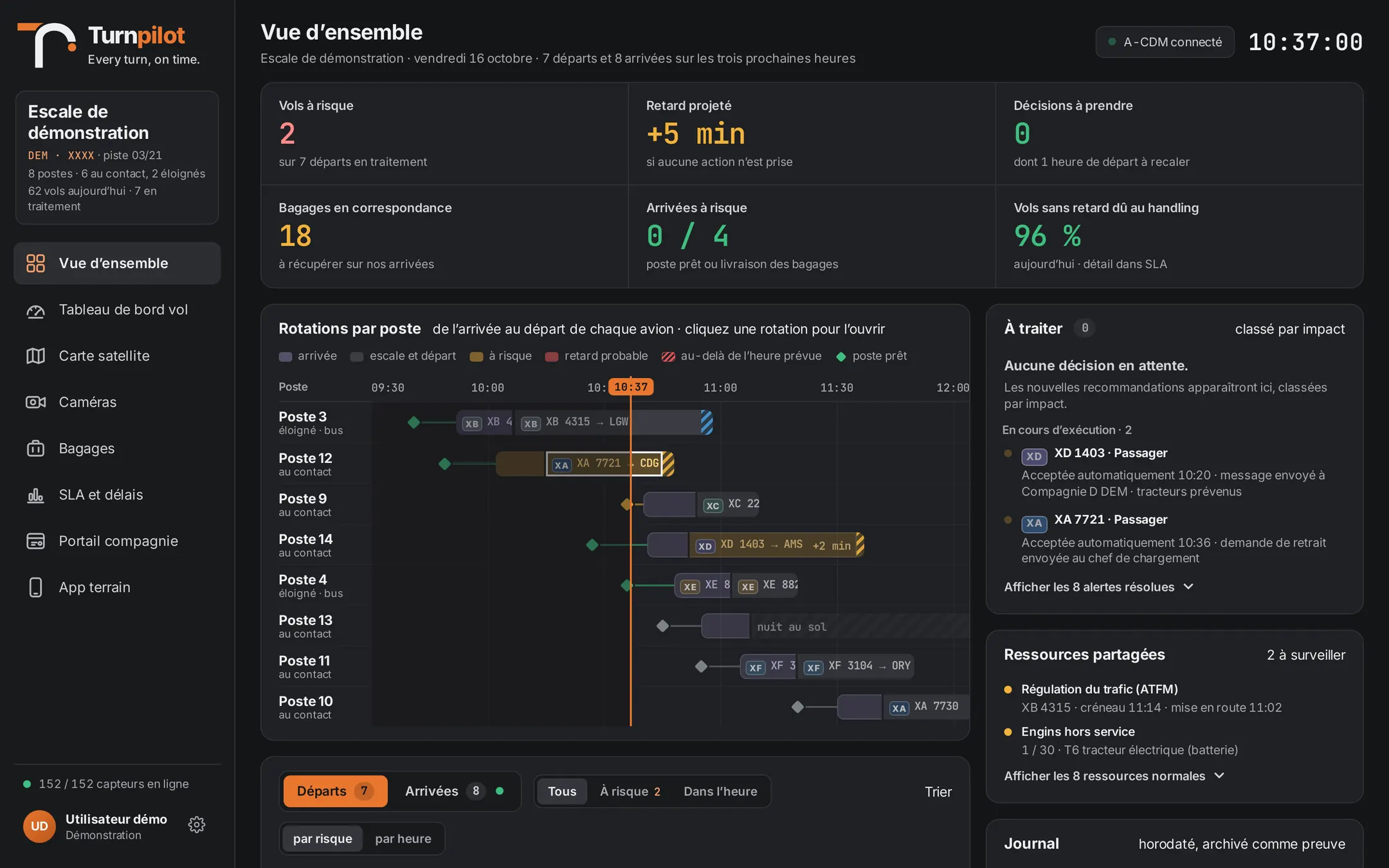
See every turnaround in real time
Every flight on the station on one screen, each with its progress and its risk to the departure time. No more calling three people to find out where a flight stands: the answer is on screen, for everyone.
Act before the delay exists
When a flight starts to slip, Turnpilot flags it while there is still time to react. Alerts are ranked by impact on the departure time, each with a suggested action. The supervisor decides; the task goes to the right team.
Prove what happened
Every step of the turn is time-stamped, with its source. When a delay minute is charged to ground handling, you have the facts to accept it, or to dispute it.
Delays build up between tools that never see each other
Every trade on a station has its own tool. Check-in and boarding live in the airline’s DCS. Bags have their reconciliation system, the BRS. Ground support equipment is managed over the radio, on a whiteboard, sometimes from memory. The aircraft itself is tracked on the airport side, through A-CDM.
Each of these tools does its job well. None of them sees the whole flight.
So the situations that cost minutes fall between the silos. The cart is ready but the tug is elsewhere. The loader expected on arrival is still working another stand. A passenger is on board while their bag is still in the make-up area. None of this shows clearly anywhere, until the delay is real, coded and charged.
The next morning the punctuality report lands. Minutes are allocated, some of them to ground handling, and the discussion with the airline starts without shared facts. To see how those minutes build up, read where handling-related delays come from.
One view per flight
For every flight, Turnpilot brings passengers, baggage, equipment and aircraft together in a single view. What the check-in agent, the baggage team leader and the supervisor each knew on their own becomes shared, current information, readable in seconds.
That view serves three moments of the day: during the bank, to make the calls; through the turn, to direct the teams; after departure, to explain and prove.
What each role sees
Station manager
A live station view: every upcoming flight, its status, its risk. At the end of the day, the list of late departures, each with its chain of time-stamped events. No more finding out about delays in the next day’s report.
Ramp supervisor
A map of the apron with its equipment and carts, a queue of alerts ranked by impact, a suggested action for each. Calls between flights are made on facts, not blind and not over the radio.
Baggage team leader
For every flight, the count of bags expected, sorted and loaded, and where the carts are. Before the holds close, they know what is missing, and where it is.
Ramp, baggage and gate agents
One task at a time on their device: the flight, the stand, the job to do. One button for “done”, another to flag a problem. No dashboard to decode, just the next job.
SLA and billing lead
Time-stamped steps for every flight, ready to export to billing and dispute handling. No more rebuilding proof of service by hand.
Seven modules, one view per flight
- Turnaround control — Every turnaround on the station in real time, ranked by risk, with a detailed timeline for each flight. Explore turnaround control
- Apron map and GSE — Know where every piece of equipment and every cart is, and which flight it serves, without the radio. See the apron map
- Baggage and holds — Bags expected, sorted, loaded: the right count before the holds close. Explore baggage tracking
- Cameras and evidence — Time-stamped images owned by the operator, to understand and to prove. Explore cameras
- SLA and delays — Every coded minute comes with its chain of evidence, ready for billing and disputes. Explore the SLA module
- Airline portal — Each airline sees its own flights, nothing more, with reports and evidence. Explore the portal
- Ramp app — One task at a time, readable with gloves on, even offline. Explore the app
For the big picture of “see, anticipate, guide, prove”, read the platform overview or browse all features.
One tool, three businesses
- Ground handlers — Fewer minutes charged to you, evidence for every flight, teams guided task by task. Turnpilot for ground handlers
- Airports — Better-informed TOBTs for A-CDM, stands released on time. Turnpilot for airports
- Airlines — The ground truth of every station, flight by flight, with the evidence. Turnpilot for airlines
Adds to your tools, never replaces them
Turnpilot does not do check-in, boarding, baggage reconciliation, staff rostering or invoicing. Those systems exist, your teams know them, your contracts depend on them. Turnpilot sits on top of the systems already in place, reads them and replaces none of them; it exchanges information with the airport’s A-CDM.
On the ramp, the app runs on the devices your teams already carry: no new hardware to wear, no double entry. As for data, what your station produces stays yours: see security and data.
The system suggests, people decide
Turnpilot makes no decision on behalf of your teams. Every alert says why it appeared and what is at stake. The supervisor accepts the suggested action, rejects it or puts it on hold; everything is logged. The call stays operational, and it stays human.
Know the trade
Ground handling has its own vocabulary: TOBT, AIBT, ULD, delay codes, SGHA. Our glossary defines them in plain words. Our resources cover the deeper topics: the key steps of a narrowbody turnaround, TOBT from the ground handler’s side, reading IATA delay codes.
Do you run a station, a ground handling company or an airline’s ground operations? Write to us: we will look together at how delays build up on your station.